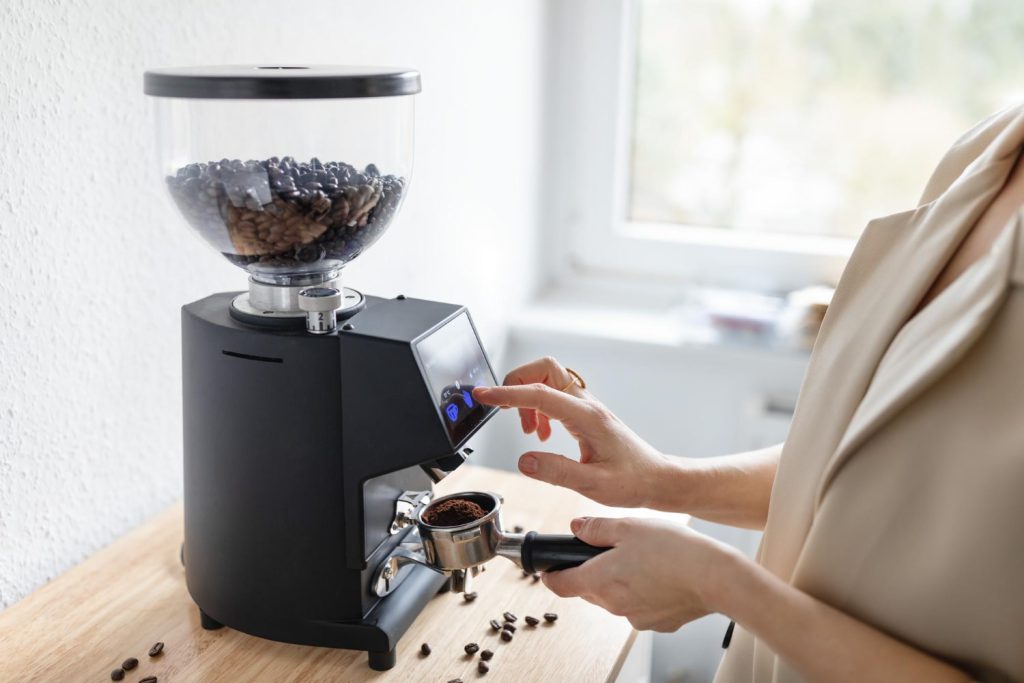
Coffee Grinder: The Heart of Espresso Flavor; Why Do You Need a Professional Coffee Grinder?
In the world of specialty coffee, there is a famous saying: “The grinder is more important than the espresso machine.” Even if you have the best coffee beans in the world and the most expensive espresso machine, if you do not use a professional coffee grinder, you will never achieve the true taste of espresso. A coffee grinder is not just a tool for crushing beans; it is a precision instrument for flavor engineering and controlling the extraction process.
1. Why is the Coffee Grinder the Heart of Espresso Flavor?
Espresso extraction is a process where water passes through a compressed puck of coffee under high pressure. If the coffee particles are not uniform, water will find paths of least resistance (a phenomenon known as channeling). A professional coffee grinder creates perfectly even particles, ensuring that water passes uniformly through the entire coffee structure to extract all the sugars and aromatic oils.
2. The Difference Between Blade and Burr Grinders
Many people start with inexpensive blade grinders, but to reach barista standards, owning a professional coffee grinder with burrs is mandatory:
- Blade Grinder: Chops beans irregularly (like a blender). The result is a powder containing both coarse chunks and very fine dust, which causes the coffee to taste simultaneously bitter and sour.
- Professional Burr Coffee Grinder: Grinds beans between two steel or ceramic burrs. This method allows the distance between the burrs to be adjusted with micron-level precision, ensuring a perfectly consistent output.
3. Types of Burrs in a Professional Coffee Grinder
When choosing a professional coffee grinder, you will encounter two main types of burrs:
A) Flat Burrs
These burrs consist of two parallel disks. Their main advantage is creating unparalleled particle uniformity, which allows the clear and sweet flavors of the coffee to shine. Most competition baristas use this type of professional coffee grinder.
B) Conical Burrs
These burrs rotate at lower speeds and generate less heat. They typically provide a heavier body and more classic flavors to the espresso. The durability of these burrs in a professional coffee grinder is exceptionally high.
Comparison Table of Coffee Grinder Types
| Feature | Standard Home Grinder | Professional Coffee Grinder (Semi-Industrial) | Industrial Grinder (Cafe) |
|---|---|---|---|
| Adjustment Precision | Limited (Coarse steps) | Very High (Stepless) | Ultra-Professional |
| Burr Material | Standard Steel | Hardened Steel or Titanium | Special Stainless Steel |
| Heat Management | Poor (Heats up quickly) | Good (Cooling system included) | Excellent (Smart fans) |
| Particle Uniformity | Average | Very High | Maximum |
4. The Importance of Stepless Adjustment
In espresso extraction, sometimes a change of just one millimeter in the distance between burrs can change the extraction time by 5 seconds. A professional coffee grinder usually features a Stepless adjustment system. This means you are not limited to specific “clicks” or steps and can make infinite micro-adjustments to the grind size to find the “golden sweet spot” of flavor.
5. Managing Heat and Static Electricity
Friction between burrs generates heat. If the heat is too high, the sensitive oils in the coffee oxidize before brewing, creating a burnt taste. A professional coffee grinder controls temperature by using powerful motors with low RPM (Revolutions Per Minute) and specialized alloys. Additionally, anti-static systems in these devices prevent coffee powder from clumping or sticking to the exit chute.
6. The Concept of Coffee Retention
In many grinders, a certain amount of ground coffee remains in the space between the burrs. In the next use, this stale coffee mixes with fresh coffee and ruins the flavor. In the design of a modern professional coffee grinder, efforts are made to bring retention close to zero (Single Dosing) so that every cup is prepared with the freshest possible grounds.
7. Buying Guide for a Professional Coffee Grinder
To buy a professional coffee grinder, you should pay attention to several key factors:
- Burr Diameter: The larger the burr diameter (e.g., 64mm or 75mm), the higher the grinding speed and the better the uniformity.
- Motor Power: A stronger motor means the device maintains a constant rotation speed under pressure, preventing damage to the burrs.
- Ease of Cleaning: Easy access to the burrs for periodic cleaning of coffee oils is essential.
- Noise Level: New models of professional coffee grinder units feature sound insulation to avoid disturbing the environment.
8. The Impact of the Grinder on Espresso Flavor Layers
When you use a professional coffee grinder, you will notice that your espresso has distinct flavor layers (fruity acidity, caramel sweetness, and chocolatey bitterness). Without a precision grind, these flavors blend together, leaving only a muddy and bitter taste. In fact, it is the grinder that unlocks the hidden potential within the coffee bean.
Conclusion
Investing in a professional coffee grinder is the smartest decision a barista or coffee lover can make. If you are looking to upgrade your coffee quality, think about getting a high-quality grinder before replacing your espresso machine. Remember that the grinder is the beating heart of the extraction process, and without it, the art of the barista can never reach perfection.
To view various models of professional coffee grinder units and receive expert advice, you can contact our specialists to help you choose the best option suited to your needs.