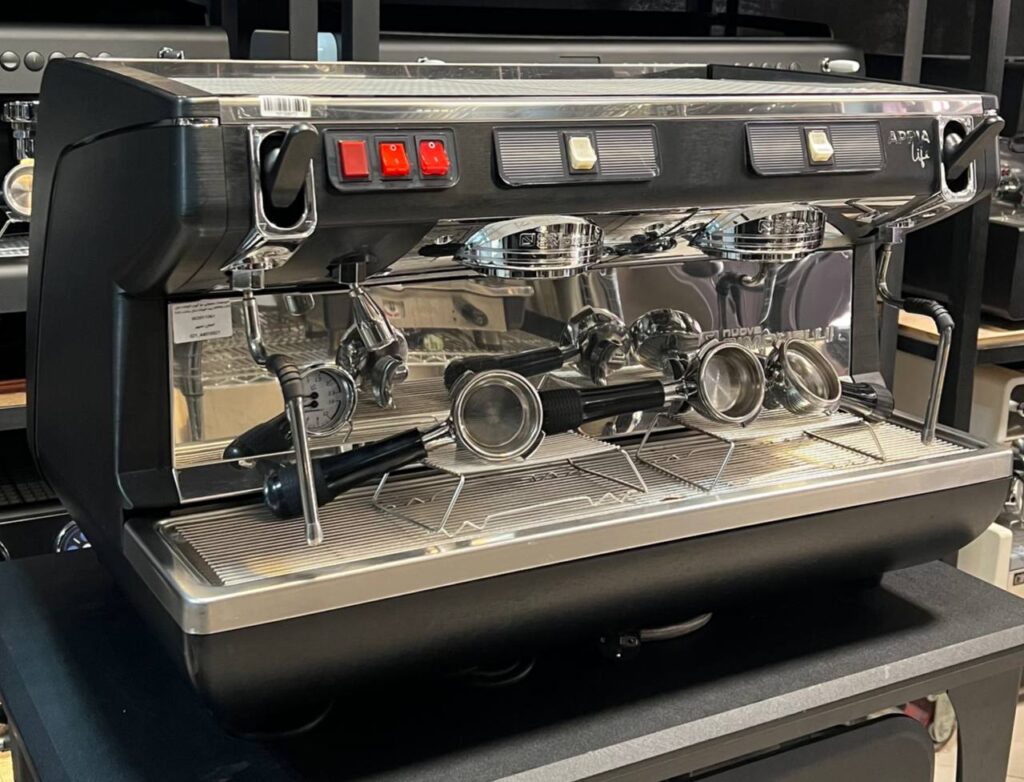
Part 1: Introduction – The Espresso Machine, More Than an Appliance, the Beating Heart and Soul of Your Café
Part 2: The Fundamental Difference Between Industrial and Domestic Machines – Why You Should Never Confuse the Two
One of the biggest mistakes new entrepreneurs make is trying to start with a high-end domestic machine in hopes of saving costs. This approach is, at best, a temporary solution and, at worst, an operational disaster. The differences between these two types of machines are much deeper than their physical dimensions and price, lying at the core of their engineering and design philosophy.
Key Features That Define an Industrial Machine:
- Strength and Durability for Non-Stop Work: Industrial machines are built with heavy steel chassis and bodies made of stainless steel or brass to withstand the heavy weight of internal components and resist the relentless use, heat, and humidity of a commercial environment. In contrast, the bodies of domestic models are mainly made of plastic and thin metal sheets.
- Boiler Power and Stability: The boilers, responsible for supplying hot water and steam, have a very high capacity in industrial models (from 5 to over 20 liters). This large capacity, along with advanced systems like a Heat Exchanger or Dual Boilers, allows the machine to simultaneously extract espresso and produce powerful steam for milk frothing without a drop in temperature—a crucial feature for a busy café.
- Rotary Pumps for Stable Pressure: Industrial machines use Rotary Pumps, which are directly connected to the water source, provide a consistent and continuous 9 bars of pressure needed for extraction, and are very quiet. In contrast, domestic models use Vibration Pumps, which are noisier and cannot maintain constant pressure during repeated use.
- Number and Design of Group Heads: Industrial machines are designed with one, two, three, or even four group heads (outlets) to handle multiple orders simultaneously. These group heads are heavy (like the E61 group heads, which weigh about 4 kg) to ensure thermal stability at the point of contact with the coffee.
- Direct Connection to Water and Drainage: To avoid the constant need to refill a water tank, all industrial machines can be directly connected to the city water system (using a filtration and softening system) and a drainage system, which makes the workflow much more efficient.
Part 3: Anatomy of a Professional Espresso Machine – Understanding the Key Components
To make an informed choice, you need to be familiar with the language of your machine. Understanding the internal components helps you grasp the real differences between models.
3.1 – The Boiler System: The Heart of Heat Production
- Single Boiler: In this simple system, one boiler is used for both producing hot water for espresso and generating steam. These systems cannot perform both tasks simultaneously and are not suitable for commercial environments.
- Heat Exchanger (HX): The most popular system in many commercial machines. A large boiler keeps water hot for steam production. A separate tube runs through this boiler, rapidly heating the incoming cold water to the appropriate temperature for espresso. This system allows the barista to pull shots and froth milk at the same time.
- Dual Boiler (DB): The most advanced and precise system. There are two separate boilers: one dedicated to hot water for espresso and another for producing steam. This system provides the ultimate control and temperature stability and is the first choice for specialty coffee shops and barista competitions.
3.2 – Temperature Control: The Vital Role of PID
A PID (Proportional-Integral-Derivative) controller is a smart thermostat that uses advanced algorithms to keep the boiler temperature stable to within a tenth of a degree Celsius. This temperature stability is essential for consistent and repeatable extraction and is one of the most important factors in the final quality of the espresso.
Part 4: Types of Machines by Automation Level – Choosing Your Workflow Style
The amount of control you have over the extraction process defines your café’s style and your team’s skill level.
– Semi-Automatic Machine: The Artist’s Choice
This machine gives the barista full control. The start and end of the extraction are controlled by the barista with a button. This model is the tool of a skilled barista who wants to extract the best flavor from every type of coffee bean by adjusting the time.
* Ideal for: Specialty coffee shops where quality and the art of the barista are a priority.
– Automatic or Volumetric Machine: The Busy Professional’s Choice
These machines ensure consistency and uniformity by allowing pre-programming of the water volume for each shot. The barista presses a button, and the machine automatically stops the process after reaching the set volume. This feature reduces human error and significantly increases service speed during busy hours.
* Ideal for: Most busy cafés and restaurants looking for a combination of quality, consistency, and speed.
– Super-Automatic Machine: The Choice of Speed and Simplicity Giants
These machines are a complete factory in a box. From grinding the beans to extracting espresso and frothing milk, everything is done at the touch of a button. Although their espresso quality is generally not comparable to other models, they are unrivaled for places that do not require a specialized barista.
* Ideal for: Hotels, large offices, self-service halls, and chain stores.
Part 5: Choosing the Right Size – How Many Group Heads Do You Need?
This decision depends directly on your business analysis. Think about the number of drinks you anticipate making during your busiest hour of the day (e.g., 8 to 9 AM).
– Single Group Machine:
- Application: Small restaurants, cafés with a limited menu, mobile businesses.
- Approximate Capacity: Up to 50 drinks per hour.
- Advantages: Lower price, smaller footprint, optimal energy consumption.
– Two Group Machine:
- Application: The gold standard for most cafés. Allows two baristas to work simultaneously.
- Approximate Capacity: Up to 200 drinks per hour.
- Advantages: Excellent balance between capacity, space, and price. Extraordinary efficiency during peak hours.
– Three Group Machine and Larger:
- Application: Very large cafés, high-traffic locations like airports, shopping malls, and chain stores.
- Approximate Capacity: Over 200 drinks per hour.
- Advantages: Maximum output capacity to manage a very high volume of orders.
Part 6: The Essential Ecosystem – An Espresso Machine Alone is Not Enough
Investing in an expensive machine without paying attention to the ancillary equipment is like buying a Formula 1 car and using regular tires.
6.1 – Coffee Grinder: The Unsung Hero
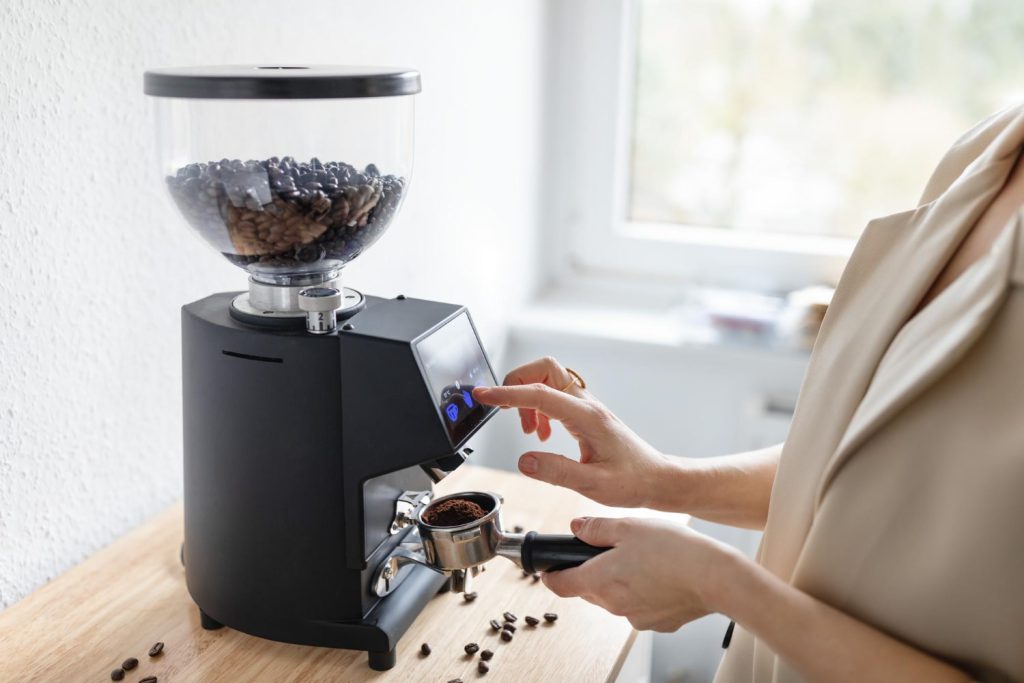
Many experts believe the coffee grinder is even more important than the espresso machine. A high-quality industrial grinder grinds coffee beans uniformly and without generating excess heat, which is crucial for a perfect extraction. Never skimp on this part.
6.2 – Water Filtration and Softening System: The Machine’s Lifeline
Over 98% of a cup of espresso is water. But more importantly, the mineral deposits in water (limescale) are your machine’s greatest enemy. These deposits can clog the boiler, pipes, and sensitive parts, leading to costly repairs. Using a standard water softening and filtration system is a requirement, not a choice.
Part 7: Top Industrial Espresso Machine Brands – The Italian and Global Titans
The market is dominated by reputable Italian brands, each with its own philosophy and expertise.
| Brand | Country of Origin | Key Features and Specialization |
|---|---|---|
| La Marzocco | Italy | The King of Specialty Cafés. Known for its dual boiler and saturated group heads, providing unparalleled temperature stability. A symbol of quality, durability, and handmade design. |
| Nuova Simonelli | Italy | The Champion of Innovation and Competitions. As the official sponsor of the World Barista Championship, it is always introducing new technologies to enhance performance and ergonomics. An excellent blend of efficiency and price. |
| La Cimbali | Italy | The Industrial and Smart Technology Giant. One of the world’s largest manufacturers, renowned for building incredibly durable machines equipped with advanced automatic technologies and energy-saving systems. |
| Bezzera | Italy | Originality and History. As the inventor of the first espresso machine, this brand symbolizes classic build quality and reliable engineering. Machines built for a lifetime. |
| Victoria Arduino | Italy | A Fusion of Luxury Design and Advanced Technology. A subsidiary of Simonelli that focuses on high-end machines with stunning designs and innovative technologies like Gravimetric technology. |
| Slayer | USA | Specialist in Flow Profiling. This American brand allows baristas to create highly complex and unique flavor profiles by manually controlling water pressure and flow. |
Part 8: The Comprehensive Maintenance Plan – How to Protect Your Significant Investment
A clean machine produces better-tasting coffee and will have a much longer lifespan.
– Daily Plan (Mandatory):
- Backflush: At the end of each day, backflush each group head with a special cleaning powder.
- Clean the Steam Wand: Wipe with a damp cloth after each use and clean with a cleaning solution at the end of the day.
- Wash Portafilters and Baskets: Soak them in a cleaning solution to remove all coffee oils.
- Clean the Drip Tray and Body: Empty and wash the drip tray and wipe down the machine’s body.
– Weekly Plan:
- Deeper Backflush: In addition to daily backflushing, once a week, remove and manually clean the shower screen of each group head.
– Periodic Plan (3 to 6 months):
- Replace Group Head Gaskets: These rubber gaskets must be replaced regularly to prevent water leakage.
- Check Water Filters: Replace the cartridges in your water filtration system according to the manufacturer’s instructions.
– Annual Plan:
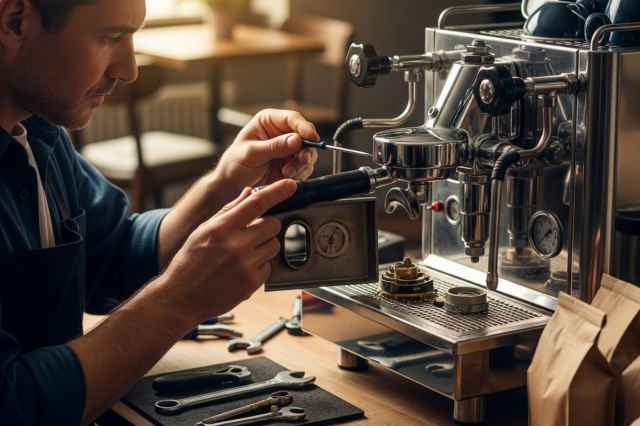
- Full Service by a Specialized Technician: Get help from an experienced technician for a general inspection, pressure adjustment, electrical component check, and potential descaling.
Final Part: Conclusion – Marlik, Your Strategic Partner in a Smart Decision
As you have seen, choosing an industrial espresso machine is a multi-dimensional decision that requires technical knowledge, business analysis, and a vision for the future. This machine is not just a tool for generating income; it is the backbone of your business’s identity and quality. Investing in the right machine will pay for itself in the long run through increased customer satisfaction, operational efficiency, and reduced repair and maintenance costs.
At Marlik Trading Company, we see ourselves not just as equipment sellers, but as your strategic partners on the path to success. Our expert team, with a deep understanding of all the technical and business aspects discussed in this guide, is ready to provide you with expert and impartial advice to help you choose a machine that aligns not only with your budget but also with your dreams and long-term goals.
To start this exciting journey and take the first step toward building a successful coffee business, contact our experts today.